
From Lab to Market: How Open Innovation is Reshaping Product Development
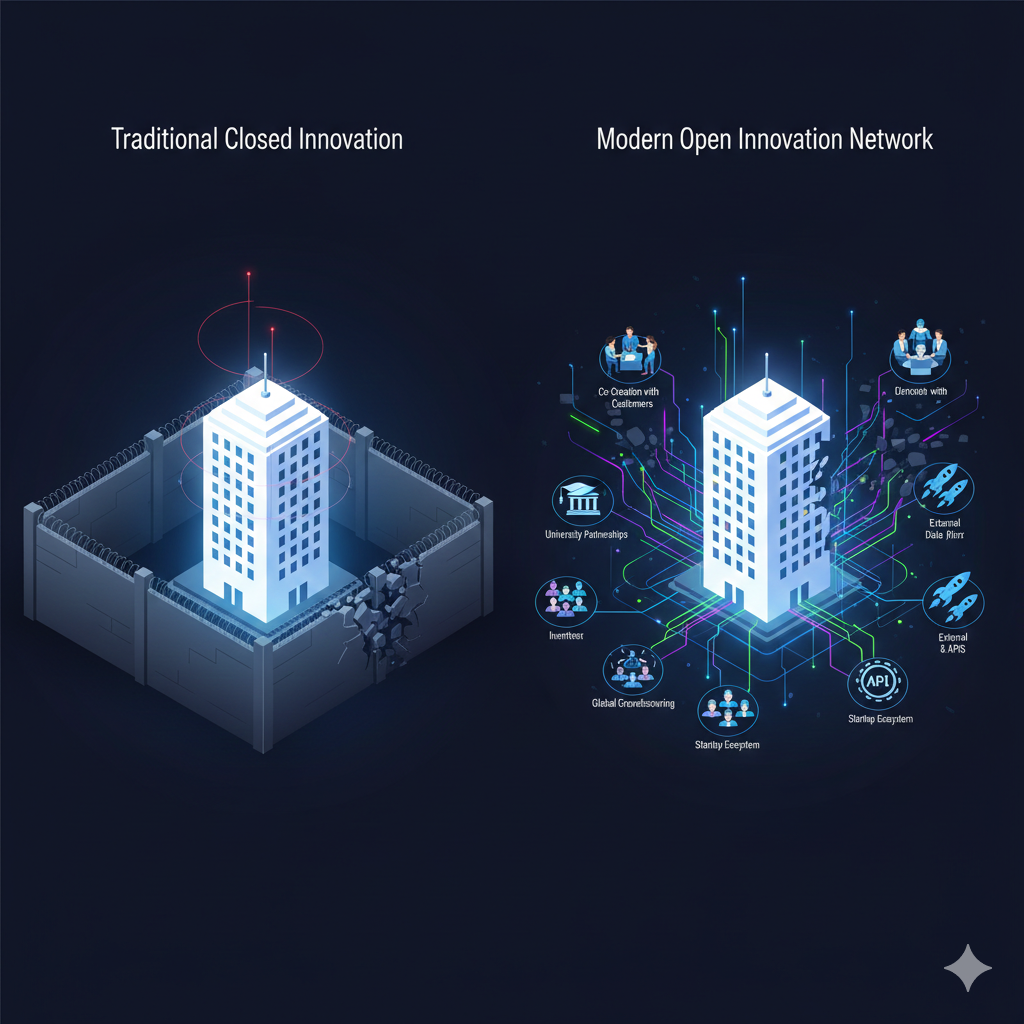
Open Innovation replaces the traditional "closed" R&D model with a collaborative framework that leverages external ideas, university research, and startup partnerships. By breaking down internal silos, companies can reduce costs and accelerate product development, turning the global ecosystem into an extension of their own laboratory.
For decades, the standard for corporate success was "closed innovation." Companies built massive R&D departments, surrounded them with high walls of secrecy, and kept their intellectual property under lock and key. The philosophy was simple: if you want it done right, and you want to own it, you do it yourself.
But in a hyper-connected world where technology moves faster than any single department can keep up with, those walls are coming down. We are entering the era of Open Innovation.
What is Open Innovation?
Coined by Dr. Henry Chesbrough, Open Innovation is the practice of businesses looking beyond their own internal walls to advance their technology and products. It assumes that "not all the smart people work for us" and that companies can—and should—use external ideas as well as internal ones to create value.
Breaking Down the R&D Silos
Traditional R&D silos often lead to "tunnel vision," where teams become so focused on their internal processes that they miss emerging trends or external breakthroughs. Open innovation frameworks disrupt this by:
Co-Creation with Customers: Instead of guessing what users want, companies involve them in the development phase. LEGO, for example, uses its "Ideas" platform to let fans design and vote on new sets.
University Partnerships: Corporations fund academic research in exchange for early access to "deep tech" breakthroughs, bridging the gap between theoretical science and commercial application.
Crowdsourcing Solutions: Platforms like InnoCentive allow companies to post "challenges" to a global community of scientists and engineers, paying only for the winning solution.
Leveraging the Startup Ecosystem
One of the most powerful forms of open innovation is the relationship between established corporations and agile startups. Large companies often struggle with speed, while startups struggle with scale.
By launching Corporate Venture Capital (CVC) arms or Startup Accelerators, giants like Google, BMW, and Unilever are able to:
Pilot New Tech: Test emerging technologies (like AI or sustainable packaging) without overhauling their main production lines.
Acquire Talent: Bring in "entrepreneurial DNA" that is often lost in large corporate structures.
Stay Disruptive: Monitor potential market threats by being part of the ecosystem that creates them.
The Risks and Rewards
Transitioning to an open model isn't without its hurdles. Companies must navigate:
Intellectual Property (IP) Complexity: Who owns an idea that was co-created by a company and a freelance engineer?
Cultural Resistance: The "Not Invented Here" syndrome, where internal teams reject external ideas out of a sense of pride or job insecurity.
However, the rewards are undeniable. Research shows that open innovation can reduce R&D costs by up to 60% and significantly shorten the "Time to Market" for new products.
Conclusion: The Future is Collaborative
The most successful products of the next decade won't be built in a basement or a secret bunker. They will be the result of a global network of collaborators, startups, and customers working in tandem. In the world of innovation, the secret to winning is no longer keeping secrets—it’s knowing how to share them.